Traveling through the Ringstrasse at first sight is overwhelming. Every direction you look is grandiose architecture and intricate details. There is an apparent effort to preserve the beauty of the history present when founding the country. Each palace is organized down to every room and artifact, memorializing the positive, and somewhat ignoring the negative. Frisby had quoted Marinetti in his text, “Otto Wagner and Vienna’s ‘Second’ Renaissance,” describing how technologies reshape how we see and experience a new urban landscape.” It was so interesting to me to see the interaction between the global importance of these historic landmarks and Viennese contemporary society.
We had visited the University of Vienna where we saw a living, breathing moment in history. Walking up the stairs and entering the double-sided glass doors, the emblem of the university engraved onto it, we were immediately taken aback with the size and fantastical appearance of the school. The ceilings made convex domes all adorned with ornate details. Walking around the school, each corridor looked like a museum, large arches and domes holding up the large lecture rooms and stairwells. We walked down the stairs and outside to see a large open courtyard in the center of the school. A large cafe was bustling with college students, all getting coffee and working on their computers. Looking out onto the courtyard, people were seated on lounging chairs enjoying homemade lunches and their friends company. We sat down at a bench and observed the relaxing environment.
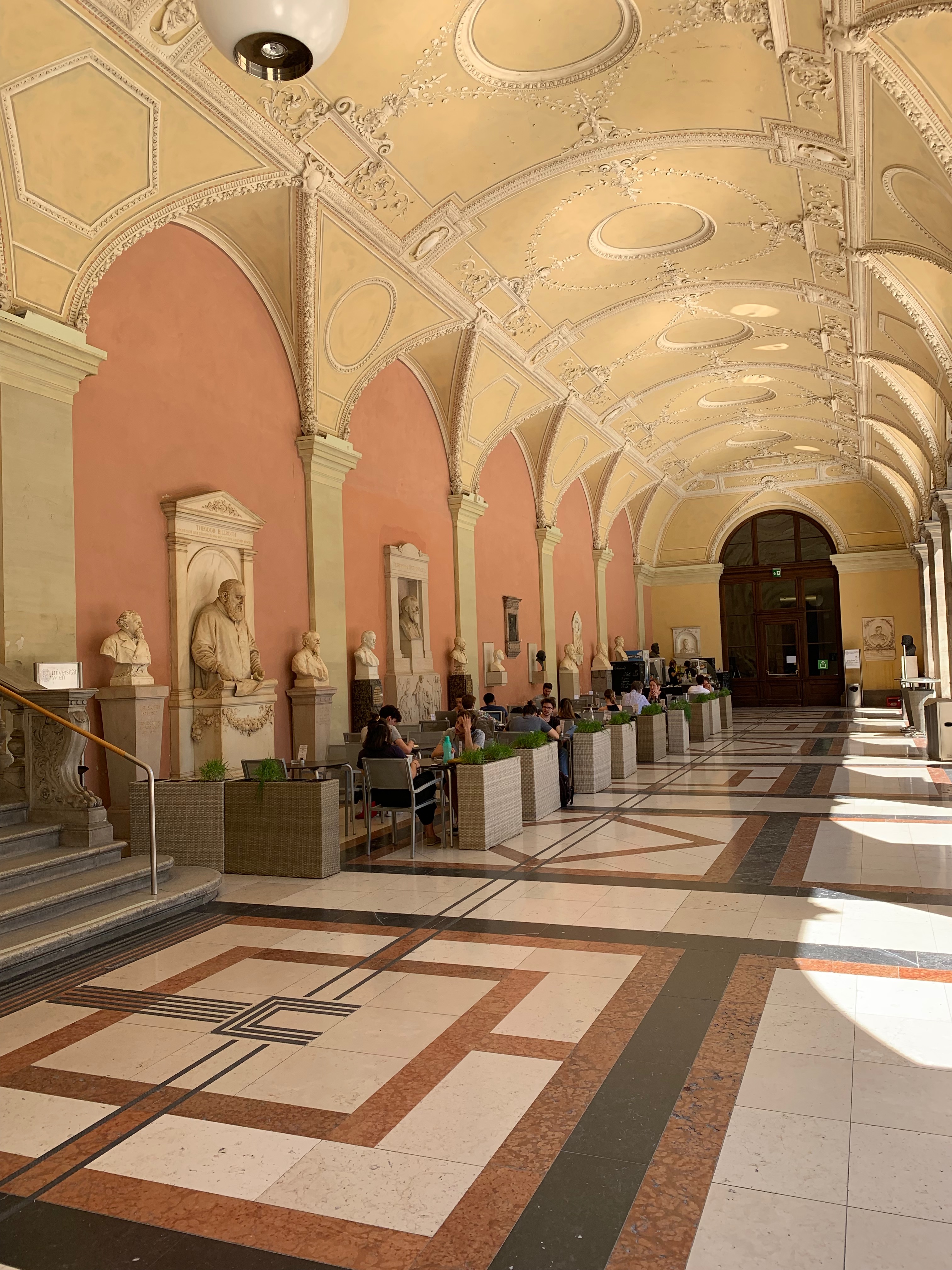
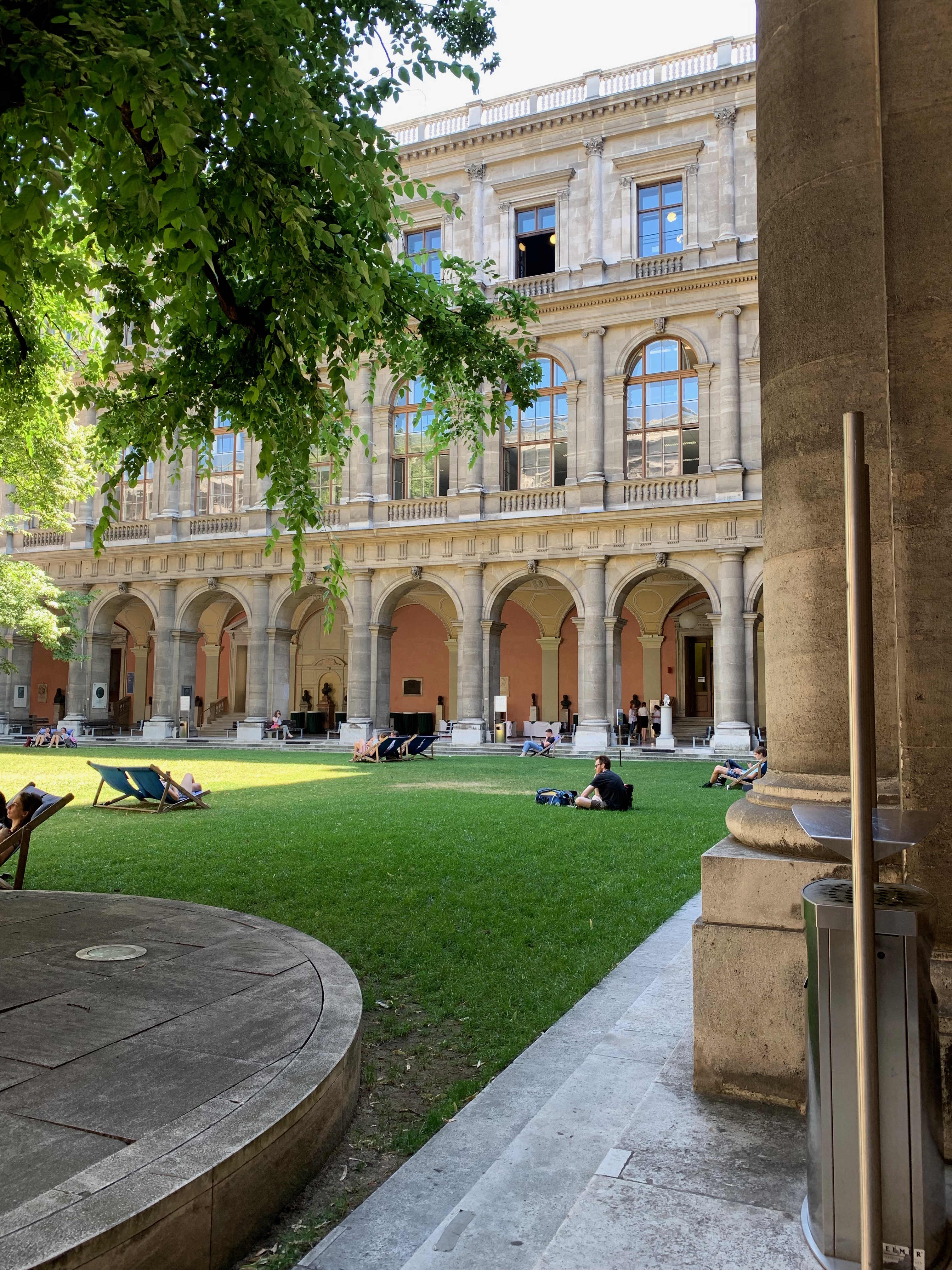
The university demonstrated the interesting conversation between present and past. On the one hand, the school seemed fantastical, something out of a fairy tale. But, seeing the cafe and the people lounging around the campus brought it to life. Another interesting point is how people subconsciously exhibit nationalistic perspectives through bringing these historic landmarks to life.
St. Charles Church also showed this same interaction between present and past. As we walked outside the U-bahn terminal and past the park just outside the church, we saw a man laying in the sun, sunbathing with nothing but a pair of shorts. It was interesting to see such a nonchalant activity outside of one of the most historically significant locations in Vienna (both representing the St. Charles Borromeo and Charles VI, an emperor of Austria).

Walking into the church was an out of body experience. Every corner of the church was embellished with beautiful religious motifs, gold-leaf covered ornaments. People were sitting and praying. I also saw a couple on their phone in the back, chatting in German. When I looked above, there were two large reflective orbs covering the top of the dome and a large elevator, taking up a quarter of the church.

These two additions at first confused and frustrated me. Why would people want to cover up something historically so beautiful with something so modern and contemporary. But, upon reflection, it was interesting to see that interaction between the times. The additions added to the experience of the church. One of the people who had worked there said that, “the installation was put in to see the reflection and give another dimension of experience to the sermons.” The elevator also gave access to a space that would have only been distant to the lacking eye. The installations provided a different perspective for the experiences that the church had offered for centuries.
The city is a historical artifact, showing the beauty and opulence of the western past. But, it is still a living city, constantly adapting to its surroundings. The fact of use alone becomes a possibility to show nationalism and pride in their past by still using the space today.
 Ananth Abroad